
The Isha Upanishad: Renunciation and Enjoyment in a Few Verses
One of the shortest Upanishads ever written spends barely twenty verses solving a problem most traditions never fully resolve: whether the spiritual life requires giving up the world, or engaging fully with it.
Most of the major Upanishads run long enough that a reader needs a guide just to keep track of where a given teaching sits in the whole. The Isha Upanishad does something almost opposite: in seventeen verses in one ancient recension, eighteen in the other, it compresses a complete position on knowledge, action, the self, and death into a text short enough to read in five minutes and spend a lifetime working through. Its brevity isn't a limitation of the teaching — it's closer to the point. Every verse in it is doing real work, with almost nothing spent on setup or repetition.
Where It Sits, and Why Its Placement Is Unusual
The Isha Upanishad forms the fortieth and final chapter of the Shukla (White) Yajurveda — a placement that already tells you something about how the tradition regarded it. Most Upanishads exist as freestanding appendices attached loosely to the end of a much larger body of ritual text, somewhat separate from the hymns and sacrificial instructions that make up the bulk of a Veda. The Isha Upanishad, by contrast, is woven directly into the closing chapter of its Veda's main body, which is part of why later commentators, including Adi Shankara, treated it with particular authority. Its short length isn't a sign of it being a minor or late addition; if anything, its integration into the Veda's core text suggests the opposite — that whoever compiled the Shukla Yajurveda in the form it survives in today considered this teaching essential enough to close the whole text with.
Everything Is Pervaded by the Lord
The opening verse sets the entire text's direction in a single line: "Isha vasyam idam sarvam yat kincha jagatyam jagat" — "All this, whatsoever moves in this moving world, is pervaded by the Lord." From this single premise, the verse draws a specific practical conclusion rather than leaving it as an abstract cosmological claim: "tena tyaktena bhunjitha, ma gridhah kasya svid dhanam" — "enjoy through that renunciation; do not covet anyone's wealth." This is the line the whole Upanishad is named for and organized around, and it's worth being precise about what it is and isn't instructing. It isn't telling a person to give up food, shelter, family, or the ordinary business of living — the text goes on, in its very next verse, to explicitly bless a full active life. What it's asking to be renounced is a specific mental posture: the sense of exclusive personal ownership over what one uses and enjoys, replaced with the recognition that everything one has access to belongs, in the deepest sense the verse is pointing at, to something larger than the individual claiming it.
A Hundred Years of Action, Not Withdrawal
The second verse removes any doubt about whether this teaching is calling for withdrawal from the world: "kurvanneveha karmani jijivishet shatam samah" — "performing works, indeed, in this world, one should wish to live a hundred years." It adds that acting in this way, a person is not bound by their actions — a direct statement that renunciation, as this text defines it, isn't renunciation of action itself but of the grasping mindset that normally accompanies it. This is a genuinely distinct answer to a tension that runs through a great deal of later Indian religious thought — the perceived conflict between the householder's active life and the ascetic's withdrawn one. The Isha Upanishad, in its opening two verses, refuses to treat that as a real conflict requiring a person to choose one path over the other. It proposes instead that the inner posture (non-attachment) and the outer form of life (a full hundred years of active work) were never actually in tension to begin with.
Seeing the Self in All Beings
The Upanishad's most quoted ethical teaching arrives at its midpoint, in a pair of verses stating that whoever sees all beings in their own self, and their own self in all beings, does not, by that very seeing, hate anyone — and that for one to whom all beings have become the self, in that state of oneness, what delusion or sorrow could possibly remain? This is offered as a description of a direct consequence rather than a moral instruction to be willed into practice: the text isn't commanding "do not hate," it's claiming that hatred specifically depends on perceiving a separateness between oneself and another, and that this particular perception, once genuinely seen through, removes the condition hatred needs to arise in the first place. Grief works the same way in this account — the verse pairs "what delusion" with "what sorrow" deliberately, treating both as symptoms of the same underlying misperception of separateness rather than as two unrelated problems needing two unrelated solutions.
The Vidya-Avidya Paradox
The Upanishad's most philosophically demanding section addresses a genuine puzzle about the relationship between worldly knowledge (avidya, sometimes rendered as ritual action or lower knowledge) and knowledge of the self (vidya, higher knowledge). The text states, almost provocatively, that those who follow avidya alone enter into blind darkness, but those who delight in vidya alone enter into a darkness that is, if anything, greater still. Taken as a pair, the two verses reject both of the obvious one-sided answers: neither pure ritual/worldly engagement without any spiritual understanding, nor pure abstract spiritual knowledge divorced from all worldly engagement, is treated as sufficient on its own.
The resolution the text gives is explicit rather than left implicit: one who knows both vidya and avidya together crosses over death by means of avidya and attains immortality by means of vidya. The verse pattern repeats in the section immediately following with a parallel pair of terms — sambhuti (the manifest, becoming) and asambhuti (the unmanifest) — applying the identical structure: exclusive devotion to either extreme alone leads to darkness, and only holding both together leads somewhere worth going. Read together, these two paired teachings form the Upanishad's central methodological claim: it consistently refuses the move of resolving a genuine tension by simply picking one side and discarding the other, insisting instead that both apparently opposed terms are jointly necessary.
The Golden Lid Over the Face of Truth
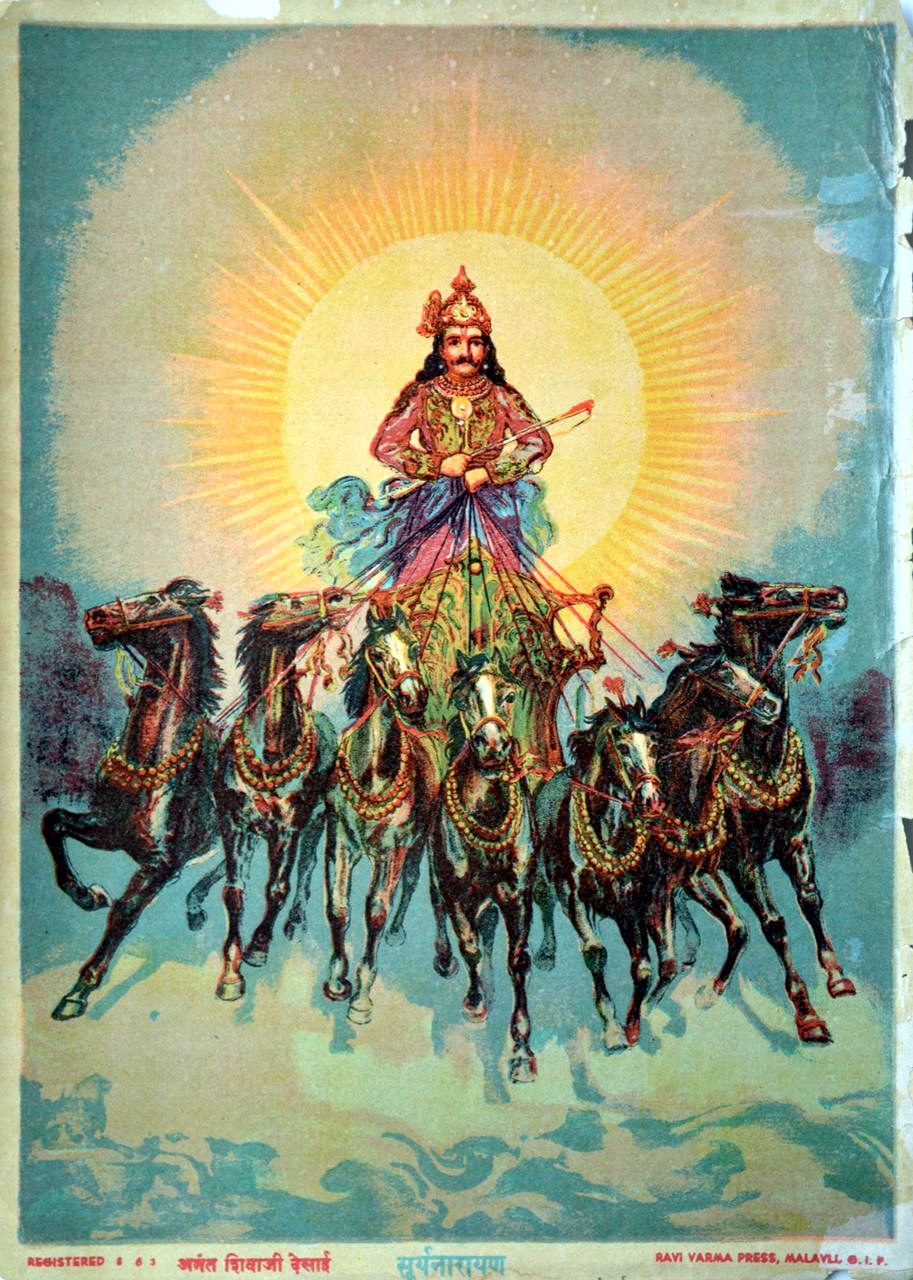
The text's closing section shifts register entirely, moving from philosophical instruction into direct prayer, addressed to the sun as the visible face of a truth it also conceals. The verse asks Pushan — a Vedic name for the sun in its nourishing aspect — to remove the golden lid covering the face of truth, so that the one who is devoted to truth may see it. The image is doing careful double duty: the sun's disc is the single most literal source of visible light available to the eye, and yet the verse treats that same brilliant disc as itself an obstruction, a covering that has to be seen past rather than simply seen. It's a fitting close to a text built around paired opposites that turn out not to be opposites at all — here, the very source of light is also what stands between the seeker and the deeper truth that light makes visible in the first place.

A Prayer for the Moment of Death
The Upanishad's final verses turn to Agni, the fire deity, with a request that reads as a dying person's prayer: lead me by the good path to prosperity, O god, you who know all our deeds; keep far from me crooked evil, and I will offer you fullest praise. Scholars including Patrick Olivelle have noted that this closing section shares specific language with material found in the Brihadaranyaka Upanishad, and that its shift in both tone and grammatical form from the philosophical verses preceding it suggests these final lines may represent a somewhat later addition to the text rather than part of its original core. That's a genuinely useful thing to know as a reader, not because it undermines the verses' authority within the tradition that has long recited them as an integrated whole, but because it explains why the text's register changes so noticeably in its last few lines — from careful metaphysical argument to something closer to liturgy, the kind of prayer a person might actually be taught to hold in mind at the moment of their own death.
What the Whole Text Is Actually Arguing
Read start to finish, the Isha Upanishad's structure traces a single, continuous argument rather than a loose collection of separate teachings. It opens by establishing that everything is pervaded by a reality larger than individual ownership, draws from that the practical instruction to act fully in the world while renouncing the grasping that normally accompanies action, extends the same logic to ethics by showing how seeing the self in others removes the basis for hatred and grief, applies the identical both-not-either structure to the vidya/avidya and sambhuti/asambhuti pairs, and closes by asking, in prayer, to see past the very brightness that both reveals and conceals the truth it's pointing toward. For a text this short, it covers an enormous amount of ground — and it does so, notably, without ever telling its reader to leave the world behind in order to find what it's describing.

Written by Ravindra Valand
Founder and researcher at AnuSutra. Tracing ancient Sanskrit scriptures (Vedas, Upanishads, Bhagavad Gita) directly from canonical Sanskrit manuscripts, exploring the nexus between contemplative spiritual practices and modern cognitive science.