
The Katha Upanishad: Nachiketa's Dialogue with Death
A boy sent to the house of Death by his own father refuses every bribe Death offers him — kingdoms, long life, every pleasure the senses can hold — until Death finally answers the one question that matters. That refusal is the entire Katha Upanishad.
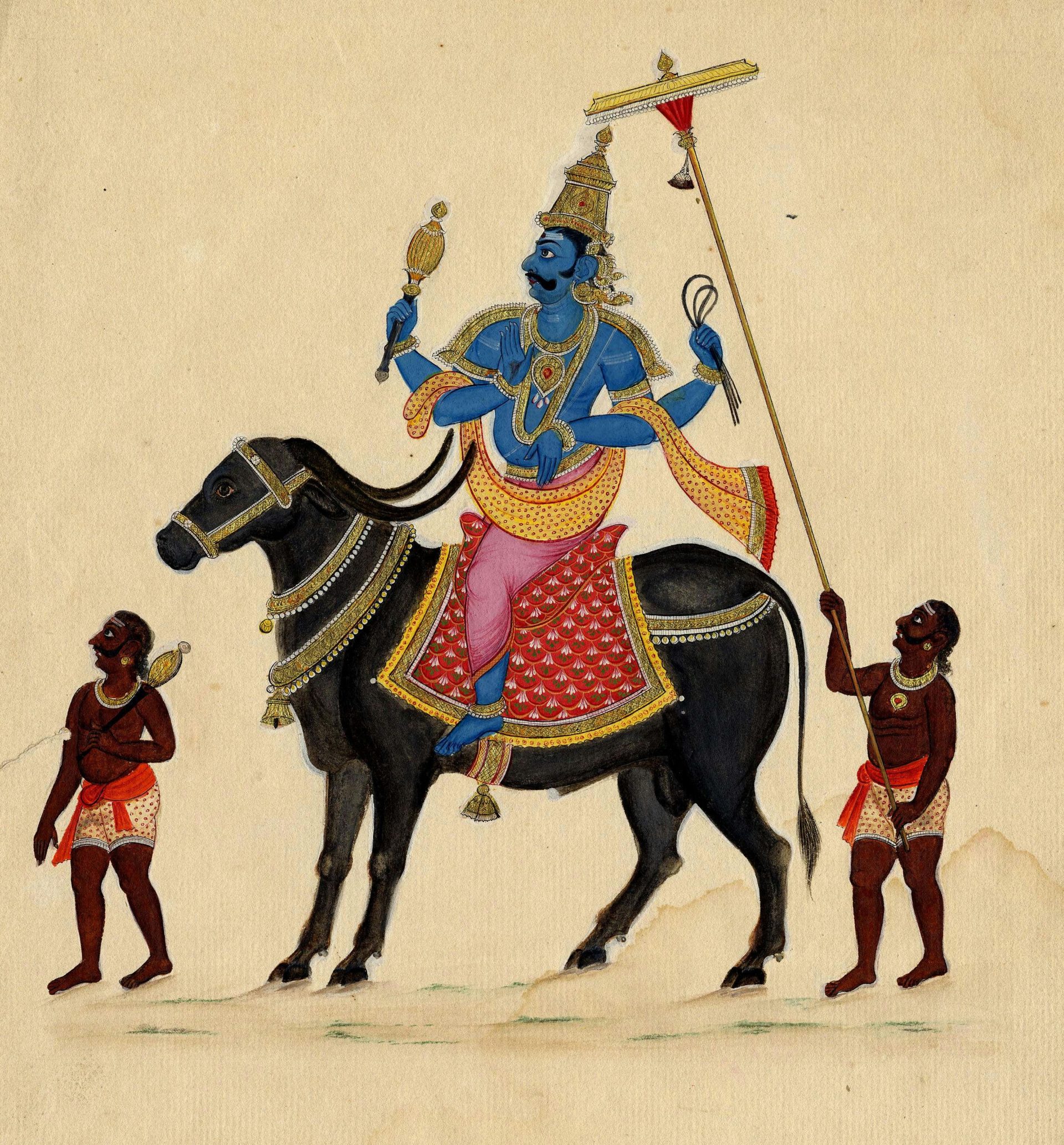
Most ancient scriptures approach death carefully, from a respectful distance, in the third person. The Katha Upanishad does something stranger: it puts a boy in a room with Death himself for three days and lets him ask anything he wants. What the boy asks for, and what he refuses to accept as a substitute answer, is the entire text. It's one of the oldest philosophical dialogues in any language that treats the fear of death not as a problem to be soothed but as a door — the one question worth walking through fire to have answered.
Who Actually Wrote This, and Where It Sits
The Katha Upanishad belongs to the Krishna (Black) Yajurveda, transmitted through the Katha school of Vedic reciters it's named after, and modern scholarship generally dates its composition somewhere between the 5th and 1st centuries BCE — old enough that its exact authorship is unrecoverable, the way most Upanishadic material is anonymous by the time it reaches a fixed written form. It's counted among the ten or so "principal" Upanishads that later commentators, most notably Adi Shankara in his 8th-century commentary, treated as authoritative enough to build a systematic philosophy on. That matters for how to read what follows: this isn't a folk tale with a moral bolted on. It's structured as a philosophical argument, delivered as a story, specifically because the story format lets it dramatize a debate that a straight philosophical treatise would have to state more abstractly — what does a person actually want, when they say they want to know the truth about death?
The Setup: A Father's Careless Vow
The story opens with a man named Vajashravasa performing a ritual sacrifice in which he's expected to give away his most valued possessions. His son, Nachiketa, notices that the cows his father is actually giving away are old, barren, and worthless — the kind of gift that satisfies the letter of the ritual while cheating its spirit. Troubled by watching his father perform an act of generosity that isn't really generous, Nachiketa asks, more than once, "Father, to whom will you give me?" — pressing the logic of the sacrifice to its uncomfortable end: if everything valuable is meant to be given, what about your own son?
Irritated by the repeated question, the father snaps: "To Death I give you." It's the kind of thing said in anger that most people would immediately walk back. Nachiketa doesn't let his father walk it back. He treats the vow as binding — a word given is a word kept, even when the person who gave it wishes he hadn't — and travels to the house of Yama, the deity who presides over death, to fulfill it. This opening detail is easy to read past, but it's doing real philosophical work: the text is establishing, before any doctrine is taught, that Nachiketa is someone who takes truth and obligation more seriously than comfort. That's the character trait the rest of the Upanishad is going to test.
Three Days at an Empty Door
Nachiketa arrives at Yama's house and finds Yama absent. In the customs the text assumes its audience already understands, a guest arriving at a house and not being properly received — offered water, a seat, food — is a serious breach of hospitality, one that traditionally falls back on the host rather than the guest. Nachiketa waits three nights at the door, without hospitality, without food.
When Yama returns and learns a Brahmin guest has been left unattended for three days, he's genuinely troubled by his own lapse, and offers three boons — one for each night Nachiketa went without a proper welcome — specifically to make amends for the breach. The number three isn't arbitrary storytelling color; it's the mechanism the narrative uses to escalate from something almost administrative (a debt of hospitality owed) to something existential (the deepest question a person can ask), one boon at a time.
The First Boon: Peace With His Father
Nachiketa's first request is modest and specifically relational: he asks that his father be free of anxiety over what he'd said, that his anger cool, and that he recognize and welcome Nachiketa warmly when he returns from Yama's house. Yama grants it without hesitation. Read on its own, this boon looks like the least interesting of the three — a boy asking to patch things up with his dad. But it's worth noticing what Nachiketa didn't ask for here: he didn't ask to undo the vow, to be released from having to visit Death at all. He accepts the situation his father's words created and asks only that the relationship survive it. It's the first sign of a pattern that holds for the rest of the text — Nachiketa consistently chooses the request that addresses what's actually broken rather than the request that would simply make the discomfort go away.
The Second Boon: A Fire That Leads to Heaven
For his second boon, Nachiketa asks Yama to teach him the specific fire ritual that leads to heaven — understood in the text's cosmology as a realm free from hunger, thirst, and the ordinary sorrows of embodied life. Yama teaches it to him, and adds something notable: this fire, he says, will henceforth be called by Nachiketa's own name, and future generations who perform it correctly will be tracing their ritual back to this exact exchange.
This boon is where the text plants a specific, concrete claim rather than a purely symbolic one — that a named fire ritual, still referenced in later Vedic ritual literature as the Nachiketa-agni, originates from this dialogue. Whatever one makes of the historical claim, the narrative purpose is clear: Yama is now demonstrating, twice, that he will give Nachiketa exactly what he asks for, generously and without holding back, on any question Nachiketa poses. It sets up the third boon to land as a real turning point rather than a formality.
The Third Boon: The Question Yama Doesn't Want to Answer
For his third and final boon, Nachiketa asks the question the entire Upanishad exists to stage: when a person dies, does something of them continue to exist, or not? He frames it precisely — some say a self persists after death, some say it doesn't, and he wants Yama, who would know better than anyone, to resolve it.
Yama's reaction is the hinge of the whole story. He doesn't answer. Instead, he tries, at length and with real persistence, to talk Nachiketa out of asking. He offers wealth, long life, sons and grandsons living a hundred years, herds of cattle, elephants, gold, a vast kingdom, and — pointedly, since he's the god of death making the offer — access to beautiful companions "not to be obtained by mortals." He tells Nachiketa this question is subtle, that even the gods have historically found it difficult, and asks him not to press the matter further.
Nachiketa's refusal is the philosophical center of the text, and it's worth quoting the logic of it rather than just the conclusion: he tells Yama that everything offered wears out the vigor of the senses over time, that even the longest life is short next to eternity, and that Yama can keep the horses, the dancing, the singing — none of it can make a person truly happy, and none of it is the thing he actually asked for. Having come this far to ask this specific question, he says, he won't accept a substitute, however lavish. This is the moment the Upanishad is actually built to deliver: a direct dramatization of the difference between what a person is offered when they ask a serious question, and what they actually asked for.
Shreyas and Preyas: The Good and the Pleasant
Once Nachiketa passes this test, Yama shifts from bargaining to teaching, and his first lesson names the exact trap he'd just tried to set. He tells Nachiketa that two things present themselves to every person: shreyas, the good — what genuinely benefits a person in the deepest and most lasting sense — and preyas, the pleasant — what feels immediately gratifying. They pull in different directions, and Yama says plainly that the wise examine both and choose shreyas, while those without discrimination, driven by desire for immediate gratification, choose preyas.
This isn't a throwaway moral aside — it's the frame the rest of the teaching hangs on, and it retroactively explains everything that just happened between them. Yama had spent several verses offering Nachiketa an enormous pile of preyas specifically to see whether he'd take it in place of shreyas. Nachiketa's refusal wasn't stubbornness for its own sake; it was the shreyas-over-preyas choice, demonstrated in action before it was ever stated as a principle. Yama tells him directly that he has examined the objects of desire that are dear and pleasant, and has rejected them — and that this is exactly what qualifies him to receive what comes next.
What Yama Actually Says About the Self
Having established that Nachiketa has earned the answer, Yama teaches that the self a person truly is — what the text calls the atman — is not born and does not die. It doesn't come from anything, and nothing comes from it; it's unborn, eternal, ancient, and not destroyed when the body that housed it is destroyed. The specific image the Upanishad uses is that if the slayer thinks he slays, and the slain thinks he is slain, both fail to understand: the atman neither slays nor is slain.
It's worth pausing on this exact verse for a reason beyond its content: this teaching, in close to its original Sanskrit wording, reappears almost word for word roughly five to eight centuries later in the Bhagavad Gita's second chapter, when Krishna gives Arjuna the same argument about the indestructibility of the self before the battle at Kurukshetra. The Gita's version swaps a couple of words — where the Katha Upanishad has vipascit ("the wise" or "the discerning one") describing who truly understands this, the Gita has kadacit ("ever," as in "never at any time") — but the core claim, that the self is unborn, eternal, ancient, and unharmed when the body is harmed, is carried across almost unchanged. It's a genuinely useful thing to know if you've read both texts: the Gita isn't inventing this metaphysics from scratch in the middle of a battlefield speech. It's drawing on teaching that already existed, in close to this exact phrasing, in an older text about a boy questioning Death directly.
Smaller Than the Smallest, Greater Than the Greatest
Yama's teaching keeps returning to a deliberate paradox about scale. He describes the self as anor aniyan, mahato mahiyan — subtler than the subtlest, greater than the greatest — seated in the heart of every living being. The point of holding both extremes together in the same phrase is to block the two most tempting misreadings: that the self is some kind of physically tiny inner spark small enough to locate and grasp, or alternatively that it's some vast cosmic entity too remote and abstract to matter to an individual life. Yama's language keeps insisting it's neither convenience — it is at once the smallest thing imaginable and the largest, present at the core of a single person's inner life and not confined by that person's boundaries either.
The teaching also insists this isn't the kind of thing you find through cleverness. Yama says the self cannot be attained by instruction, by intellectual power, or by extensive learning — it's attained only by the one the self itself chooses to be revealed to, someone whose seeking is genuine rather than merely intellectual curiosity dressed up as spiritual seeking. It's a pointed thing for Yama to say to a Brahmin's son who has, up to this moment, been demonstrating exactly the kind of sharp intellectual reasoning that resisted Yama's bribes. The text seems aware of the tension and resolves it by suggesting Nachiketa's discernment was necessary but not, on its own, sufficient — necessary to clear away the false answers, but the real teaching is still described as something given, not something derived.
The Parable of the Chariot
The Upanishad's best-known passage, and arguably the clearest single teaching device anywhere in the early Upanishadic literature, is the parable of the chariot, laid out across several consecutive verses in the text's third section. Yama tells Nachiketa to know the self as the rider seated in the chariot, the body as the chariot itself, the intellect (buddhi) as the charioteer, and the mind (manas) as the reins. The senses, in this image, are the horses, and the objects the senses chase after are the roads those horses run down.
The teaching that follows the image is precise about what determines a good or bad outcome. When a person lacks discrimination and their mind is never held in check, their senses become like the unbroken horses of a bad charioteer — uncontrolled, running wherever the immediate object of desire pulls them, with the rider along for a ride he never chose. When a person has discrimination and a controlled mind, the senses become like well-trained horses, responsive to the rein, going where the charioteer actually intends to go. The verses go further still, describing a hierarchy above even the intellect — beyond the senses are their objects, beyond the objects is the mind, beyond the mind the intellect, beyond the intellect the "great self," and beyond even that the unmanifest, with the person as the final point along that chain. It's a map of interiority laid out as a nested sequence, each layer subtler and more governing than the one before it, ending in something the text treats as the ultimate ground rather than one more layer to transcend.
What makes the chariot image durable enough to still be the first thing many people learn about this text is that it doesn't ask for any prior metaphysical commitment to make sense. Anyone who has noticed the gap between what they intend to do and what their impulses actually drive them toward already has the raw experience the parable is describing. The Upanishad's move is to give that common experience a precise internal geography — naming exactly which part is meant to be in charge, and what it looks like when it isn't.
The Razor's Edge
One of the Upanishad's most quoted single lines describes the difficulty of the path this teaching points toward: uttisthata jagrata prapya varan nibodhata; ksurasya dhara nisita duratyaya durgam pathas tat kavayo vadanti — "arise, awake, having approached the great, learn; the sages say the path is difficult to cross, like the sharpened edge of a razor." The image works on more than one level at once: a razor's edge is thin enough to demand total, continuous attention, and it's also the instrument of precision rather than force — you don't cross it by pushing harder, you cross it by placing your attention exactly right, moment to moment.
It's worth being precise about what the metaphor is and isn't claiming. It isn't saying the teaching is available only to an elite few through some inherently unfair filter. It's describing the nature of sustained, careful attention itself — the same quality of focus a razor's edge demands of anyone walking it, regardless of who they are. The "arise, awake" framing that opens the verse reinforces this: the obstacle isn't a locked door reserved for the specially gifted, it's ordinary inattention, the drift of a mind that's fallen asleep to what it's actually doing. The remedy the verse proposes is exactly what it names — waking up, in the most literal sense the words allow.
The Syllable That Names the Imperishable
Later in the teaching, Yama identifies a specific single word as the concentrated essence of everything the Vedas point toward: Om. He tells Nachiketa that this syllable is what all the Vedas glorify, what all austerities proclaim, and what those who live a life of disciplined study aim toward — and that this single syllable is Brahman, the imperishable, and this syllable is also the highest goal itself. Whoever knows this syllable, Yama says, obtains whatever they wish.
This passage matters for understanding how the Katha Upanishad connects to material covered elsewhere in this pillar. The Mandukya Upanishad, a much shorter text devoted entirely to analyzing the syllable Om across the states of waking, dreaming, and deep sleep, takes as its entire subject something the Katha Upanishad states here in a handful of verses as one part of a larger teaching. Reading them together, the picture that emerges is of a shared reverence for Om running across multiple, independently composed Upanishads rather than a single text's idiosyncratic emphasis — which is itself a data point about how central this one syllable was to the tradition these texts came out of.
Where the Word "Yoga" Itself Comes From
Near the end of the teaching, Yama uses a specific technical term for the state he's been describing throughout — the condition of the senses being firmly restrained, the mind steady, the intellect unwavering. He calls this yoga, and states plainly that this steady restraint of the senses is what the wise call yoga, adding the caution that one should remain vigilant in this state, since it can be attained and lost. This is one of the earliest surviving occurrences of the word "yoga" used in this specific, technical, inward sense — not yet the elaborate eight-limbed system that Patanjali would systematize centuries later in the Yoga Sutras, but the same core claim that later system builds on: that steadiness of attention, held against the pull of the senses, is itself the discipline the word names.
It's a useful corrective to a common assumption — that "yoga" originates as a physical practice and only later acquires philosophical content. The evidence in a text this old points the other way: the philosophical claim (steady inward attention as the defining feature of the disciplined mind) is present here, in one of the oldest Upanishads to use the term this way, well before any surviving text systematizes yoga as a structured practice with named postures or stages.
What Nachiketa Actually Walks Away With
The Upanishad closes by telling us that Nachiketa, having received this teaching from Death himself — the doctrine of the self, and the full account of the discipline of yoga — attained Brahman, became free from passion and death, and that anyone else who knows this teaching in the same way attains the same thing. It's a deliberately understated ending for a text this ambitious: no final miracle, no dramatic reunion, just the statement that the boy who asked the hardest possible question, and refused every attempt to buy him off with an easier one, got the actual answer, and that the answer itself was the thing that resolved what he'd originally been afraid of.
Read as a whole, the Katha Upanishad's real argument isn't really about death in the narrow sense of what happens biologically when a body stops functioning — the text has surprisingly little interest in that question on its own terms. Its argument is about what a person is actually asking for when they say they want to understand death, and what happens to someone who's offered every comfortable substitute for that answer and turns all of them down. Nachiketa's three boons, read together, trace a single throughline: peace with his father, then a fire ritual whose entire purpose is securing a good afterlife, then finally the question underneath both — not "how do I get a good outcome after death," but "what, if anything, actually survives it." The Upanishad's answer is that this last question can't be bought, bargained for, or granted as an afterthought to something easier. It has to be the thing you actually came for.

Written by Ravindra Valand
Founder and researcher at AnuSutra. Tracing ancient Sanskrit scriptures (Vedas, Upanishads, Bhagavad Gita) directly from canonical Sanskrit manuscripts, exploring the nexus between contemplative spiritual practices and modern cognitive science.