
Sandhyavandanam: Astronomical Timing, Gayatri Science & Daily Vedic Sadhana
Master the ancient chronobiology of Trisandhya, the mathematical formula for solar transitions, and the neuroscience of the 24-syllable Gayatri Mantra.
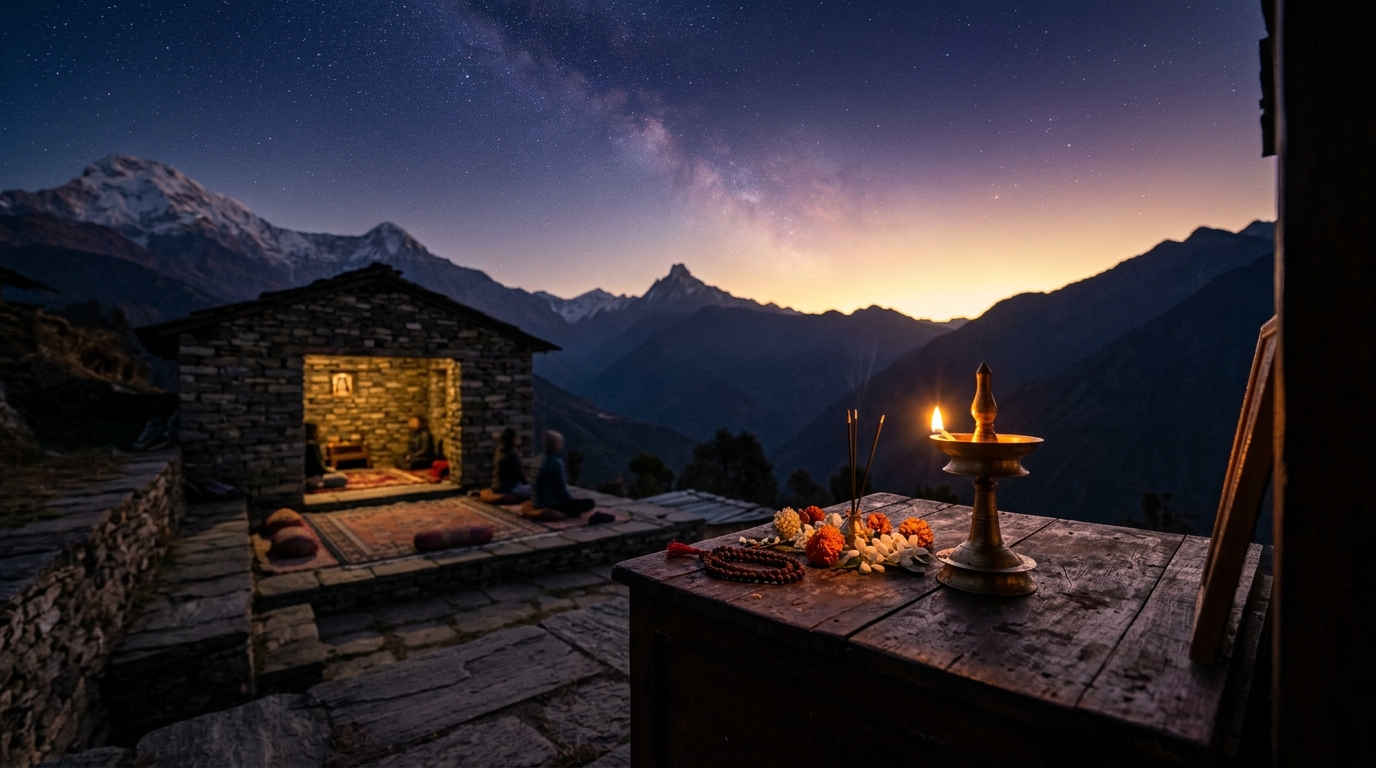
In the vast corpus of Sanatana Dharma, while specific Pujas, Yagyas, and Vratas are classified as Kamya Karmas (optional actions undertaken for specific fruits), one discipline stands apart as the non-negotiable bedrock of daily spiritual life: Sandhyavandanam (संध्यावन्दनम्). Categorized as a Nitya Karma—an obligatory daily duty whose practice incurs spiritual purification and whose neglect causes internal stagnation—Sandhyavandanam is widely considered the oldest surviving continuous liturgical meditation practice on Earth.
Far from being mere blind ritualism, Sandhyavandanam is a precision-engineered chronobiological science aligning human physiology with celestial solar transitions (Sandhis). Anchored by the venerated Gayatri Mantra from the Rigveda, this practice integrates conscious breath retention (Pranayama), neuro-vagal parasympathetic stimulation, hydrodynamic water purification (Marjanam & Arghyam), and focused solar attunement (Savitri Upasana). This master guide provides the exact mathematical calculation for Trisandhya, the Vedic scriptural injunctions, and the physiological neuroscience behind this ancient daily discipline.
1. What Does "Sandhya" Mean? The Mathematics of the 3 Junctions (Trisandhya)
The word Sandhya is derived from the Sanskrit roots Sam (harmonious, complete) and Dhyai (meditation, contemplative focus). It signifies the "juncture" or transitional seam where two distinct cosmic states meet:
- Pratah Sandhya (Dawn Junction): The transition from nocturnal darkness to the rising sun.
- Madhyahnika Sandhya (Solar Noon Junction): The exact moment when the sun reaches its highest solar zenith in the sky.
- Sayam Sandhya (Dusk Junction): The transition from daylight into twilight and nocturnal darkness.
The Astronomical Calculation
Just as with Brahma Muhurta, performing Sandhyavandanam according to a static clock time (e.g., arbitrarily saying "always at 6:00 AM") is scientifically and scripturally inaccurate. The Vedic day is dynamic and referenced strictly to your local ephemeris coordinates.
| Sandhya Phase | Astronomical Window | Exact Timing Definition | Ideal Practice Window |
|---|---|---|---|
| Pratah Sandhya (Morning) | Stars visible to Sunrise | Starts when stars are still faintly visible, ends as the solar disc touches the horizon. | 24–48 minutes prior to local sunrise. |
| Madhyahnika (Noon) | Solar Midday | The exact meridian passage where the sun's altitude is maximal for that day. | 24 minutes before to 24 minutes after solar noon. |
| Sayam Sandhya (Evening) | Pre-Sunset to Starlight | Starts while the sun is still a glowing red orb on the horizon, continues through twilight until the first stars appear. | 24 minutes before to 24 minutes after local sunset. |
Devotees can verify their exact local solar zenith and sunrise coordinates daily via AnuSutra Panchang.
2. Scriptural Injunctions: Why Sandhyavandanam is the Mother of the Vedas
The Taittiriya Aranyaka (2.2) of the Krishna Yajurveda and the Manusmriti (2.101–103) explain that the very sanctity of the seeker is sustained through regular Sandhya:
सन्ध्याहीनोऽशुचिर्नित्यमनर्हः सर्वकर्मसु।
यदन्यत्कुरुते कर्म न तस्य फलभाग्भवेत्॥
— Daksha Smriti (2.34)
"One who neglects Sandhyavandanam is perpetually impure and unsuited for higher spiritual rites. Whatever other actions they perform bear no lasting fruit."
The reason is simple: Sandhyavandanam cleanses the karmic and physiological detritus accumulated during daily worldly engagements. Just as the physical body requires daily bathing (Snana) to shed cellular sweat and dust, the pranic body (Pranamaya Kosha) and mental sheath (Manomaya Kosha) require rhythmic reset at nature's energetic crossroads.
3. The 7 Pillars of the Sandhyavandanam Protocol
While regional variations exist across Rigvedic, Yajurvedic, and Samavedic recensions, all authentic traditions share seven immutable pillars:
1. Achamanam (Hydro-Electric Grounding)
Sipping water three times from the palm while chanting the names of the Divine (Achyutaya Namah, Anantaya Namah, Govindaya Namah). Mechanically, the contact of cold water against the soft palate stimulates the vagus nerve and the glossopharyngeal reflex, inducing acute alertness while simultaneously grounding nervous agitation.
2. Pranayama (The 1:4:2 Rhythmic Reset)
Controlled breath retention paired with the mental recitation of the full Maha-Vyahritis (Om Bhuh, Om Bhuvah, Om Suvah, Om Mahah, Om Janah, Om Tapah, Om Satyam) and the Gayatri Siras. Holding the breath (Kumbhaka) gently elevates arterial carbon dioxide ($CO_2$), triggering cerebral vasodilation (the Bohr effect) to maximize cerebral oxygen delivery.
3. Marjanam (Cellular Purificatory Hydration)
Sprinkling purified water droplets upon the crown of the head (Brahmarandhra) with the tips of the fingers while chanting the Apo Hishta suktas. In Vedic physics, water (Apas) is revered as the primal solvent carrying subtle electromagnetic memory (Prana).
4. Aghamarshana (Expulsion of Internal Negativity)
Taking water in the right palm, holding it near the right nostril, drawing out mental impurities through visual contemplation, and casting the water to the left earth. This ritual externalizes unconscious psychological guilt and cognitive burdens, resetting emotional baseline neutrality.
5. Arghya Pradanam (Cosmic Solar Offering)
Offering oblations of water to the rising or setting sun with joined palms (Anjali Mudra). In Vedic allegory, the Arghya repels the "Mandeha" demons—symbolizing the forces of lethargy, inertia, and depression (Tamas) that threaten to eclipse the light of human consciousness.
6. Gayatri Japa (Pineal Photonic Attunement)
The supreme crest-jewel of the ritual: sitting in silent, motionless posture (Siddhasana), covering the hands, and repeating the sacred Gayatri Mantra with exact phonetic intonation:
$$\text{ॐ भूर्भुवः स्वः तत्सवितुर्वरेण्यं भर्गो देवस्य धीमहि धियो यो नः प्रचोदयात् ॥}$$ $$\textit{(Om Bhūr Bhuvaḥ Svaḥ Tat Savitur Vareṇyaṁ Bhargo Devasya Dhīmahi Dhiyo Yo Naḥ Pracodayāt)}$$
7. Upasthanam & Abhivadana (Gratitude & Lineage Acknowledgment)
Standing to face the sun in reverence (Upasthanam), saluting the four cardinal directions, and reciting one’s ancestral lineage (Gotra, Pravara, Veda, and Sutra). This practice bridges personal identity with transgenerational ancestry, anchoring the practitioner in humble continuity.
(Devotees looking for a serene, ad-free digital mala counter to maintain exact Japa counts during morning or evening Sandhya can explore our comprehensive research on the Gayatri Mantra in the Rigveda).
4. Modern Neuroscience & Biophysics of Gayatri Resonance
What occurs within the brain and autonomic nervous system when the Gayatri Mantra is vibrated at the dawn solar transition?
A. 24 Syllables & the 24 Neural Nodes
The Gayatri Mantra is structured in the strict poetic meter of Gayatri Chandas (three lines of eight syllables each: $3 imes 8 = 24$). Classical treatises note that each of these 24 syllables corresponds directly to 24 major nerve plexuses (Chakras and Granthis) along the cerebrospinal axis. The rhythmic tongue movements required to enunciate Sanskrit dental, palatal, and labial consonants stimulate the hypothalamus and pituitary glands via cranial nerve pathways.
B. Alpha-Theta Neural Synchrony
EEG studies conducted on experienced meditators chanting the Gayatri Mantra demonstrate a pronounced spike in bilateral frontal Alpha (8–12 Hz) and deep Theta (4–7 Hz) coherence within 5 minutes of practice. This state induces profound mental calmness while maintaining razor-sharp cognitive vigilance—the physiological definition of Sthitaprajna described in the Bhagavad Gita.
C. Circadian Melatonin & Serotonin Modulation
Performing Sandhya outside facing the rising or setting sun provides immediate retinal exposure to low-solar-angle lux and infrared light spectrums. This photons-to-retina transmission synchronizes the master circadian clock in the suprachiasmatic nucleus (SCN), driving daytime serotonin production and optimizing nocturnal melatonin release for restorative sleep.
5. Frequently Asked Questions (FAQ)
Can women and seekers of all backgrounds practice Gayatri meditation?
Yes. Classical scriptures such as the Brihadaranyaka Upanishad and the Rigveda celebrate great women Rishikas—including Gargi, Maitreyi, and Lopamudra—who wore the sacred thread (Yajnopavita) and mastered the Gayatri. The pure repetition of the Gayatri Mantra for inner illumination is universal to all seekers striving for mental purity (Chitta Shuddhi).
What if my work schedule prevents doing Sandhya at exact sunrise?
Vedic texts provide the concept of Gow-Dohana Kala (grace periods). While performing Sandhya at the exact celestial seam yields maximal energetic benefit, doing it before initiating daily worldly labor is vastly superior to omitting it entirely. If delayed, one performs a brief Prayaschitta Arghya to restore energetic equilibrium.
Is Sandhyavandanam purely a religious ritual?
No. While it honors the Supreme Light, structurally it is an advanced system of preventative medicine combining rhythmic lung expansion, hydrotherapy, sun exposure, vagus nerve stimulation, and linguistic neuro-priming.
Explore scholarly Upanishadic commentaries, daily planetary ephemeris math, and authentic Sanskrit scripture expositions on AnuSutra.
Discover Your Dominant Guna Constitution
Evaluate your balance of Sattva, Rajas, and Tamas according to Chapter 14 of the Bhagavad Gita with our self-inquiry quiz.

Written by Ravindra Valand
Founder and researcher at AnuSutra. Tracing ancient Sanskrit scriptures (Vedas, Upanishads, Bhagavad Gita) directly from canonical Sanskrit manuscripts, exploring the nexus between contemplative spiritual practices and modern cognitive science.
Related Sacred Studies
The Gayatri Mantra: Its Actual Source in the Rigveda and What It Means
Before it became one of the most widely recited verses in the world, the Gayatri Mantra was a single, specific hymn to the sun, composed by a named sage, in one of the Rigveda's oldest sections.
The Brahmanas and Aranyakas: The Texts Between the Vedas and the Upanishads
Between the Vedic hymns and the philosophical Upanishads sits a layer of Vedic literature most people have never heard of — ritual manuals giving way, gradually and on purpose, to forest texts that stopped taking the rituals quite so literally.
The Four Mahavakyas: The Upanishads' Great Sayings, Explained Together
Four short sentences, one drawn from each of the four Vedas, are traditionally treated as the compressed summary of everything the Upanishads are trying to say. Read separately they sound like four different claims. Read together, they're one.