
Nishkama Karma: The Bhagavad Gita's Psychology of Action Without Attachment
Deconstruct the Sanskrit logic of Verse 2.47, understand why detachment is not apathy, and master the cognitive psychology of detached peak performance.
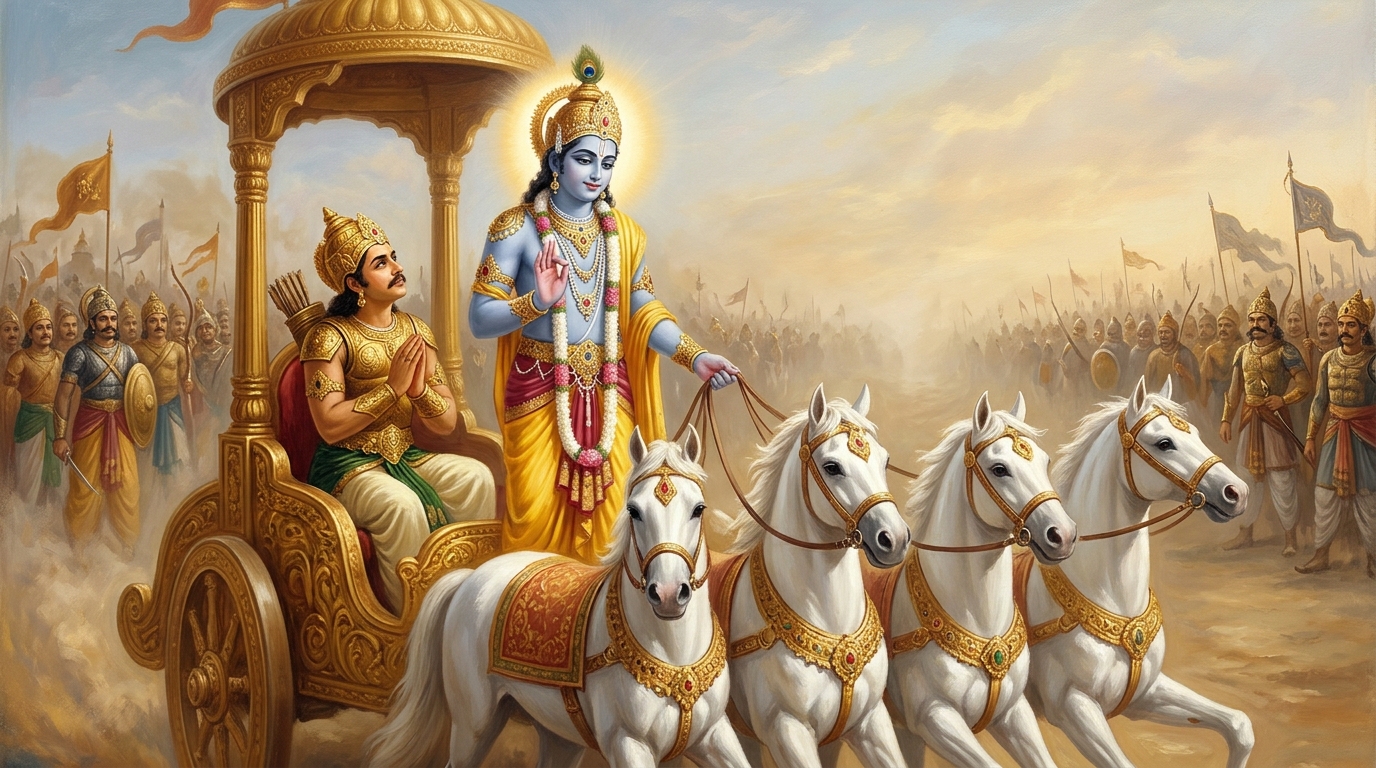
Almost anyone who has encountered the Bhagavad Gita has heard the phrase: "Do your duty without expecting the fruits of your action." It is printed on motivational posters, quoted by corporate management gurus, recited in commencement speeches, and repeated in modern spiritual circles with such casual frequency that its original psychological force has been almost entirely blunted.
When reduced to a bumper-sticker aphorism, Nishkama Karma (निष्काम कर्म) sounds either impractical or downright depressing. To the modern ambitious professional, working hard while claiming to "care nothing about the outcome" feels like a psychological contradiction—or worse, a convenient rationalization for mediocrity, complacency, and apathy. If you genuinely do not care whether your project succeeds, why put in eighty hours a week building it? If a surgeon genuinely does not care whether the patient survives the operation, would you want them holding the scalpel?
This common reaction stems from a profound linguistic and philosophical misunderstanding of what Krishna is actually presenting in the second, third, and fourth chapters of the Gita. Nishkama Karma is neither stoic suppression nor cynical detachment. It is not an invitation to passive fatalism, nor is it a religious demand for self-abnegation.
Properly understood, Nishkama Karma is an extraordinarily precise cognitive psychology of peak performance, mental equilibrium, and existential freedom. It addresses the single most destructive cognitive error human beings make: conflating the execution of an action with the fruit of that action.
1. The Anatomy of a Misunderstood Verse: Deconstructing 2.47
To understand what Krishna is demanding of Arjuna, we have to look past the loose English translations and examine the exact fourfold architectural syntax of Chapter 2, Verse 47:
कर्मण्येवाधिकारस्ते मा फलेषु कदाचन।
मा कर्मफलहेतुर्भूर्मा ते सङ्गोऽस्त्वकर्मणि॥
— Bhagavad Gita (2.47)(Karmaṇy-evādhikāras te mā phaleṣhu kadāchana
mā karma-phala-hetur bhūr mā te saṅgo ’stvakarmaṇi)
This single shloka is constructed out of four distinct, non-negotiable jurisdictional boundaries:
Clause 1: Karmaṇi eva adhikāras te
"Your authority (adhikāra) pertains solely to action itself."
The Sanskrit term Adhikāra (अधिकार) does not merely mean "right" in the modern legalistic sense; it means jurisdiction, domain of agency, and operational capability. You have absolute sovereignty over what you choose to initiate right now—your focus, your craftsmanship, your ethical boundaries, your deliberate effort.
Clause 2: Mā phaleṣhu kadāchana
"Never, under any circumstances (kadāchana), does your authority extend to the fruits (phala)."
The term Phala (फल) literally means "fruit" or systemic harvest. The outcome of any action is never a mono-causal event. The moment an action leaves your hands, it enters a massively distributed, multi-variable universe governed by countless factors you do not control: other people’s choices, market dynamics, timing, physical physics, and karmic momentum. You control the seed; the weather and the soil belong to the cosmos. Claiming jurisdiction over the harvest is a cognitive hallucination.
Clause 3: Mā karma-phala-hetur bhūḥ
"Do not let the fruit of action be your motive (hetu)."
This is the psychological crux: do not allow an imagined future outcome to be the emotional engine driving your present action. When future anxiety or desire drives the work, your consciousness is fragmented between where you actually are and an imaginary future scenario that does not yet exist.
Clause 4: Mā te saṅgo ’stv akarmaṇi
"Nor should you have any attachment to inaction (akarma)."
Anticipating Arjuna’s immediate counter-argument—"If I have zero control over the fruit, why should I bother acting at all? I will drop my weapons and retreat to the forest"—Krishna immediately closes the door on cynicism. Refusing to act out of spite, fear, or disillusionment is still a form of outcome-addiction; it is attachment inverted into despair.
2. Structural Analysis: Sakama Karma vs. Nishkama Karma vs. Akarma
To make this distinction actionable, we can map how consciousness operates across the three states of action defined across the Gita and traditional Vedanta commentaries:
| Dimension | Sakama Karma (सकाम कर्म) | Nishkama Karma (निष्काम कर्म) | Akarma / Tamasic Inertia (अकर्म) |
|---|---|---|---|
| Motivational Engine | Kama (Egoic desire for specific praise, wealth, status, or validation). | Svadharma (Intrinsic duty, craft excellence, and universal alignment). | Bhaya / Alasya (Fear of failure, resentment, or lethargic apathy). |
| Cognitive Focus | Split: 50% on the immediate task, 50% on future reward/punishment. | Unified: 100% presence in the craftsmanship of the immediate stroke. | Dissipated: Paralyzed by endless overthinking and rationalized withdrawal. |
| Emotional Response to Victory | Manic exhilaration, inflated ego, anxiety about defending gains. | Quiet satisfaction, gratitude, immediate return to equanimity. | Cynical indifference or hidden envy. |
| Emotional Response to Defeat | Devastation, bitterness, chronic depression, paralysis. | Clear diagnostic review of variables without egoic collapse. | "I knew it was pointless anyway" (self-validating pessimism). |
| Karmic Consequence | Accumulates Karmashaya (psychological impressions binding future rebirth). | Chitta Shuddhi (Purification of the mental apparatus, liberating consciousness). | Accumulates Tamas (mental inertia and dullness). |
3. Why Detachment is Not Apathy: The Cognitive Feedback Loop
The most damaging misconception about Nishkama Karma is that it requires emotional numbness or indifference. In reality, the Gita describes the exact opposite: Nishkama Karma is the prerequisite for flawless, uninhibited focus.
Consider what actually happens in human neurobiology when you perform a high-stakes action with extreme outcome-obsession (Sakama):
- The Amygdala Hijack: When your sense of identity, self-worth, and existential safety is held hostage by the outcome of a presentation, an exam, an athletic tournament, or a creative project, your nervous system interprets failure not merely as an informational data point, but as an existential threat.
- Cognitive Tunneling: The brain’s prefrontal cortex—responsible for nuanced decision-making, pattern recognition, and lateral problem-solving—is starved of resources as the sympathetic nervous system triggers fight-or-flight cortisol release.
- Execution Choking: You over-monitor your fine motor skills and internal dialogue. The tennis player double-faults on match point; the public speaker's voice quivers; the programmer introduces frantic bugs. You fail precisely because you care too desperately about the result.
Now consider the mental landscape of Nishkama Karma: By consciously acknowledging that the outcome belongs to the broader systemic matrix (Daivam, Desha, Kala), you relieve the nervous system of the impossible burden of predicting and controlling the uncontrollable.
Your entire reservoir of cognitive bandwidth, sensory acuity, and creative intuition collapses into the singular millimeter of the present moment. You care deeply about the work—so deeply that you refuse to insult the work by treating it as a mere stepping stone toward an ego-gratifying trophy.
"Yoga is skill in action." (योगः कर्मसु कौशलम् — Gita 2.50)
Krishna does not say yoga is sitting in a cave avoiding the world; he explicitly defines spiritual yoga as supreme dexterity, grace, and artistry in action. And you cannot be dexterous if your hands are shaking with anxiety over tomorrow’s verdict.
4. The Three Gunas in Action: How Internal Quality Dictates the Work
In Chapter 14 and Chapter 18 of the Gita, Krishna explains that all physical and mental activity is mediated by the three fundamental qualities of nature (Prakriti): Sattva (clarity, harmony), Rajas (frenetic passion, agitation), and Tamas (lethargy, delusion).
(Seekers who wish to assess their current primary energetic baseline can explore our detailed Gunas Diagnostic Framework).
A. Tamasic Action (Destructive / Deluded)
Action undertaken out of blind infatuation, disregarding one’s own capacity, causing injury to others, or born of pure lethargy. The Tamasic actor avoids responsibility, blames external circumstance, and retreats into substance use or endless escapism when challenged.
B. Rajasic Action (Hyper-Attached / Ego-Driven)
Action undertaken with great strain, fueled by intense egoic craving for prestige, competitive dominance, and public validation. The Rajasic actor works obsessively, views colleagues as rivals, burns out repeatedly, and experiences violent mood swings oscillating between euphoria when winning and rage or depression when losing.
C. Sattvic Action (Nishkama / Lucid)
Action performed because it is aligned with order (Rita) and natural duty (Svadharma), free from infatuation or hatred, executed by an individual who is free from self-congratulatory boasting, and carried out with unwavering patience and resolve regardless of success or failure.
5. Adi Shankara’s Hermeneutic: Chitta Shuddhi as the Gate to Jnana
In his classical eighth-century commentary on the Bhagavad Gita (Bhashya), Adi Shankaracharya addresses a difficult philosophical question:
If ultimate liberation (Moksha) is achieved solely through self-knowledge (Jnana), why does Krishna spend so many chapters urging Arjuna to fight, act, and work in the world?
Shankara's answer is profound: Karma itself cannot grant liberation directly, but Nishkama Karma is the indispensable, non-negotiable soil in which self-knowledge takes root.
An agitated, desire-ridden mind (Ashuddha Chitta) is like turbulent water churned by a storm. You cannot see the jewel resting on the riverbed through boiling waves. No amount of listening to Upanishadic wisdom (Shravana) or repeating "Tat Tvam Asi" (I am That) will liberate a seeker whose mind is perpetually boiling with lust for praise and terror of blame.
Nishkama Karma functions as the ultimate psychological detergent. Every time you act with excellence and consciously release claim over the praise or blame, you scrape away a layer of Vasana (subconscious latent tendencies) and Ahankara (ego-identification). Over months and years of disciplined practice, the mental mirror becomes smooth and dust-free. Into that purified, motionless mind (Chitta Shuddhi), the light of non-dual truth reflects effortlessly and permanently.
6. How to Practice Nishkama Karma in Modern Life: A 4-Step Operational Framework
How does an ordinary person—navigating corporate deadlines, family responsibilities, financial mortgages, and creative aspirations—actually apply this without retreating into an ashram?
Step 1: Identify Your Authentic Svadharma
Before acting, ask: Is this action genuinely mine to perform? Does it align with my real duties, competencies, and stage of life, or am I doing this out of FOMO, vanity, or imitation of someone else’s journey? Working someone else's path out of desire for their rewards is the root of cognitive dissonance (Paradharmo bhayāvahaḥ — Gita 3.35).
Step 2: Establish the "Input-Only" Boundary
Draw a conscious line down the center of your consciousness. On the left side write: Variables I 100% control (my integrity, preparation, attention, kindness, promptness). On the right side write: Variables I do not control (the client's mood, the algorithm, the promotion decision, macroeconomic shifts). Pour 100% of your energy into the left column; give the right column absolute zero emotional rent.
Step 3: Practice "Ishvara Pranidhana" (Systemic Surrender)
At the conclusion of a task, deliberately release the mental thread. Do not keep refreshing the page for comments, likes, email replies, or approval. Mentally offer the completed work into the larger universal order (Brahmarpanam). Say: "I have crafted this to the best of my current capacity. The systemic result belongs to the universe."
Step 4: Neutralize the Reaction to the Verdict
When the result arrives:
- If it is favorable: Acknowledge the role of grace, timing, and other people's assistance. Do not let your ego inflate.
- If it is unfavorable: Treat it as cold, valuable informational feedback on execution variables. Do not take it as a verdict on your existential worth. Adjust the craft and begin the next action cleanly.
7. Frequently Asked Questions (FAQ)
Does practicing Nishkama Karma kill modern ambition and innovation?
No; it purifies and sharpens it. Ambitious leaders operating from Nishkama Karma are vastly more dangerous competitors and resilient innovators because they cannot be psychologically blackmailed by temporary setbacks. While competitors panic, cut ethical corners, or fall into despair after a failed product launch, the Nishkama practitioner studies the failure calmly, iterates without egoic shame, and continues executing with surgical clarity.
What is the exact difference between Karma Yoga and Nishkama Karma?
They are two sides of the same coin: Karma Yoga is the broad spiritual discipline (Marga) of using active worldly work as an instrument of spiritual realization. Nishkama Karma is the specific psychological attitude (action devoid of selfish desire) that transforms ordinary labor into Karma Yoga. Without Nishkama, work is merely worldly exertion (Karman); with Nishkama, work becomes prayer and liberation (Yoga).
What does "Karmanye Vadhikaraste" mean word by word?
- Karmani: In action
- Eva: Only / solely
- Adhikarah: Your authority / jurisdiction / agency
- Te: To you
- Ma: Never / not
- Phaleshu: In the fruits / outcomes
- Kadachana: At any time / under any circumstance
Can a beginner practice detached action immediately?
Begin with low-stakes daily moments: wash the dishes without demanding praise from your spouse; pick up a piece of litter without needing anyone to witness it; write a thoughtful email without checking whether the recipient replies immediately. Train the neural pathways on small actions before attempting it on high-stakes career crossroads.
Conclusion: The True Freedom of Action
The ultimate paradox of the Bhagavad Gita is that surrendering claim to the fruit does not diminish the harvest; it simply liberates you from being consumed by it.
When you no longer depend on external outcomes to tell you who you are, the chronic tension that underlies modern life evaporates. You fight when fighting is required; you build when building is required; you rest when resting is required—free from the anxious tyranny of praise and blame, centered in the eternal sanctuary of your own self.
Explore scholarly Upanishadic commentaries, Vedic scripture guides, and authentic Sadhana tools across AnuSutra.
Discover Your Dominant Guna Constitution
Evaluate your balance of Sattva, Rajas, and Tamas according to Chapter 14 of the Bhagavad Gita with our self-inquiry quiz.

Written by Ravindra Valand
Founder and researcher at AnuSutra. Tracing ancient Sanskrit scriptures (Vedas, Upanishads, Bhagavad Gita) directly from canonical Sanskrit manuscripts, exploring the nexus between contemplative spiritual practices and modern cognitive science.
Related Sacred Studies

The Gita's Chapter 4: Krishna's Avatar Declaration and the Yoga of Knowledge in Action
Chapter 4 is where Krishna stops arguing about grief and duty and makes a much larger claim about himself — then spends the rest of the chapter explaining why the claim matters less than what a person does with their own actions.

Dharma in the Bhagavad Gita: What "Do Your Duty" Actually Means in the Text
"Do your dharma" gets repeated as a one-line summary of the whole Gita, but the text is specific about what that actually means — and it's not the same claim as "obey whatever role you're assigned." Here's the argument, chapter and verse.

The Three Yogas of the Gita: Karma, Bhakti, and Jnana, Explained Through the Text Itself
Action, devotion, and knowledge — the Gita presents all three as genuine paths to the same goal, not a hierarchy with one correct answer. Here's what each one actually argues, chapter and verse, not the flattened one-line version.