
The Purusha Sukta: The Rigveda's Hymn of the Cosmic Being
Sixteen verses in the Rigveda's tenth book describe a single cosmic being sacrificed by the gods, with everything that exists — the sky, the sun, the Vedas, even the social order — emerging from the pieces. Scholars generally agree it's one of the youngest hymns in the whole collection.
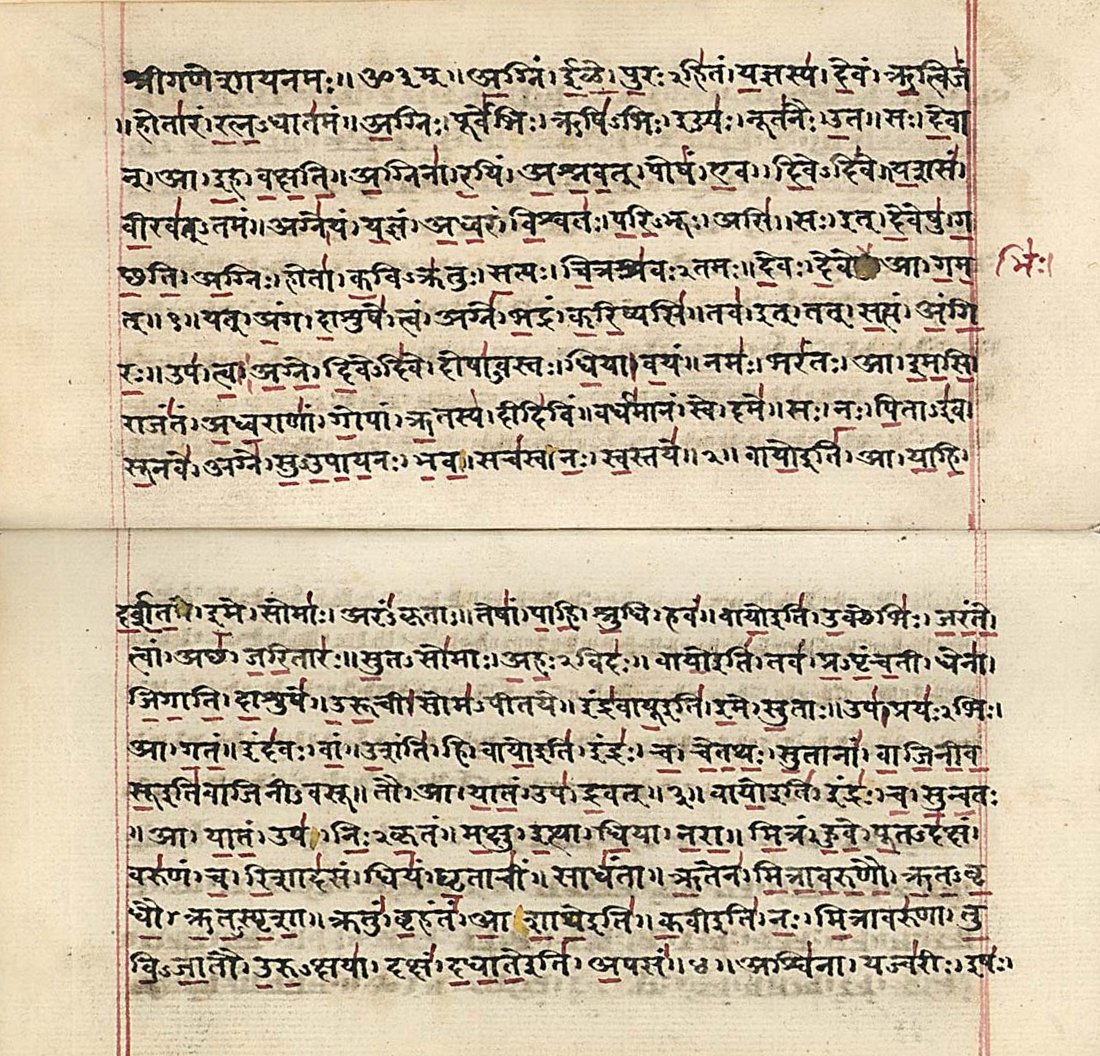
The Rigveda's tenth book contains a sixteen-verse hymn, catalogued as hymn 90 and generally known as the Purusha Sukta, that offers a strikingly different creation account than the more philosophically abstract Nasadiya Sukta a few hymns later in the same book. Where the Nasadiya Sukta describes creation through a kind of primordial unfolding from an undifferentiated, questionable origin — "who really knows," it famously asks — the Purusha Sukta describes something more concrete and more violent: a single, all-encompassing cosmic being, dismembered in a great sacrifice, with everything in existence emerging from the pieces.
Purusha: A Being With a Thousand of Everything
The hymn opens by describing Purusha in terms meant to convey totality through sheer excess of scale: he has a thousand heads, a thousand eyes, a thousand feet, and pervades the earth on every side while still extending ten fingers' width beyond it. He is, the hymn states, whatever has existed and whatever is yet to come, the lord of immortality, and — in a formulation that anticipates the Bhagavad Gita's later, similarly totalizing descriptions of Krishna's own nature — is also identified with everything that grows through food, meaning the entire physical, sustained-by-nourishment world as well.
The hymn treats even the visible universe as only a fraction of the whole: it states that this greatness belongs to Purusha, but that Purusha himself is even greater, with three-quarters of his being immortal in the sky while one quarter of him became this entire visible world — an early and striking image of ultimate reality as vastly exceeding whatever portion of it happens to be manifest and observable.
The Sacrifice
The hymn's central event is a cosmic sacrifice: the gods, using Purusha himself as the sacrificial offering, perform a yajna in which spring is the clarified butter, summer the fuel, and autumn the oblation. From this sacrifice, the hymn states, curds and butter were produced, along with the animals of the air, the forest, and the village. From it the Rigveda itself was born, along with the Samaveda, the meters of Vedic verse, and the Yajurveda — an image that places the sacred texts themselves among the things generated by Purusha's dismemberment, rather than treating them as somehow prior to or separate from it.
The natural world follows the same pattern: from Purusha's mind the moon was born, from his eye the sun, from his mouth Indra and Agni, from his breath the wind. From his navel arose the atmosphere, from his head the sky, from his feet the earth, from his ear the cardinal directions — a complete cosmography, built entirely out of the anatomy of one sacrificed being, each part of the visible world correlated with a specific part of Purusha's body.
The Four Varnas, and Why This Section Reads Differently
The hymn's most historically consequential and most scrutinized verse is the one describing the origin of the four varnas, the traditional social categories of Hindu society: from Purusha's mouth came the Brahmin, from his arms the Rajanya (the warrior/ruler class, later more commonly called Kshatriya), from his thighs the Vaishya, and from his feet the Shudra.
This is the only place in the entire Rigveda where all four varnas are named together and given an explicit cosmological, sacrificial origin, and this specificity has made the verse a focal point for a considerable amount of modern textual scholarship. Linguists and historians of the Vedic corpus, including researchers such as Stephanie Jamison, Joel Brereton, and Vijaya Nagarajan, have generally concluded, based on linguistic and stylistic analysis, that the Purusha Sukta as a whole belongs to a comparatively late layer of the Rigveda, likely composed considerably after most of the collection's other hymns, and that the varna-origin verse specifically may represent an even later interpolation into the hymn — added, on this reading, to lend cosmological and scriptural authority to a social hierarchy that was still solidifying at the time the hymn (or at least this section of it) was actually composed, rather than describing a division that had existed, in fixed form, since the very beginning of Vedic society.
This is a case worth being precise about rather than glossing over: the hymn's continued religious significance — it remains in active liturgical use today, recited in a range of Hindu rituals — exists alongside a body of textual scholarship that treats its most socially consequential single verse as one of the Rigveda's latest additions rather than one of its oldest, foundational statements.
A Hymn Later Traditions Kept Building On
Beyond its immediate content, the Purusha Sukta's basic structural idea — a single, all-encompassing being whose dismemberment or self-extension generates the entire cosmos — became a template later Hindu texts returned to repeatedly in different forms. The Bhagavad Gita's eleventh chapter, in which Krishna reveals a cosmic form containing all beings, all worlds, and all time simultaneously, and the broader concept of Vishnu's Vishvarupa (universal form) found across later Puranic literature, both work with essentially the same underlying idea the Purusha Sukta introduces: totality made briefly, overwhelmingly visible, before receding back into a more limited, personal form the observer can actually relate to. The Purusha Sukta is where that specific way of imagining the ultimate first appears in the Vedic corpus, sixteen verses into the Rigveda's final book, describing a being large enough to contain the sky, the seasons, the scriptures, and — in its most debated verse — the entire structure of the society reciting the hymn.
Discover Your Dominant Guna Constitution
Evaluate your balance of Sattva, Rajas, and Tamas according to Chapter 14 of the Bhagavad Gita with our self-inquiry quiz.

Written by Ravindra Valand
Founder and researcher at AnuSutra. Tracing ancient Sanskrit scriptures (Vedas, Upanishads, Bhagavad Gita) directly from canonical Sanskrit manuscripts, exploring the nexus between contemplative spiritual practices and modern cognitive science.
Related Sacred Studies

The Four Vedas Explained: What's Actually Inside Hinduism's Oldest Scriptures
Most people who say "the Vedas" couldn't name what's actually in them. Here's what's genuinely inside each of the four — the Rigveda's hymns, the Yajurveda's ritual manuals, the Samaveda's melodies, and the Atharvaveda's spells for daily life.
The Gayatri Mantra: Its Actual Source in the Rigveda and What It Means
Before it became one of the most widely recited verses in the world, the Gayatri Mantra was a single, specific hymn to the sun, composed by a named sage, in one of the Rigveda's oldest sections.
The Maha Mrityunjaya Mantra: The Rigveda's Great Death-Conquering Hymn Explained Word by Word
Found in the seventh mandala of the Rigveda, the Maha Mrityunjaya Mantra is one of Hinduism's most revered invocations. A word-by-word textual exploration reveals that its prayer is not a desperate plea to escape physical death, but an ancient metaphor for natural, fearless spiritual liberation.