
The Gita's Chapter 9: Raja Vidya, the Royal Secret Teaching
Krishna calls what he's about to say the king of sciences and the king of secrets — then, unusually for a text often read as demanding renunciation, states that it's easy to practice.
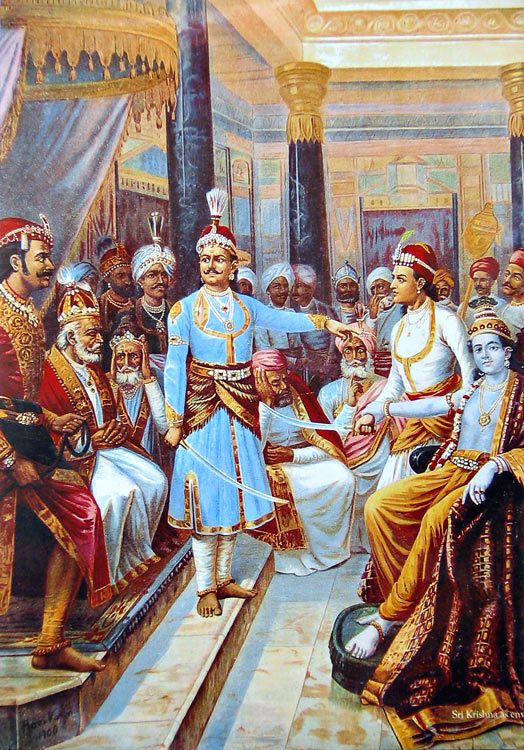
The Bhagavad Gita's ninth chapter opens with a promise of unusual confidence. Krishna tells Arjuna, who has already received a considerable amount of philosophical instruction across the preceding eight chapters, that he's now going to reveal something even more secret — a piece of knowledge that, once understood alongside direct experience of it, will free Arjuna from the misfortune of continued worldly existence entirely. The chapter's title, Raja Vidya Raja Guhya Yoga, names the two claims Krishna makes for what follows: raja vidya, the king of sciences, and raja guhya, the king of secrets.
Uttamam, Pavitram, and — Unusually — Su-sukham
Verse 9.2 lays out four specific qualities of this teaching, and the fourth is the one that stands out against the general reputation the Gita sometimes has as a text of severe discipline and difficult renunciation. The knowledge is described as uttamam, supreme; pavitram, purifying; pratyaksha-avagamam, directly realizable through one's own experience rather than taken purely on faith; dharmyam, in accordance with righteousness; and su-sukham kartum, easy to perform. That last quality is the one worth dwelling on: a text capable of describing extraordinarily demanding practices elsewhere — the meditation instruction of chapter 6, the total self-abnegation implied by chapter 2's philosophy of action without any attachment to results — here characterizes its "supreme secret" as something that isn't, in fact, difficult to actually do.
What Krishna goes on to describe bears this out. The chapter's core teaching, developed across its middle verses, is devotion — bhakti, though the specific technical vocabulary of chapter 12's later treatment isn't yet fully in place here — expressed through remarkably ordinary, accessible actions. Verse 9.26 states that whoever offers Krishna a leaf, a flower, a fruit, or even water, with devotion, he accepts that offering from the one who made it with a devoted heart. There's no requirement here for elaborate ritual, Sanskrit fluency, wealth sufficient for costly offerings, or years of prior training. The bar for entry, as this chapter describes it, is devotion itself, not the material scale or ritual correctness of what's being offered.
"Even the Most Sinful Person"
Chapter 9 makes a claim about accessibility that later readers, particularly within bhakti-centered traditions, have treated as one of the most theologically consequential statements in the entire text. Verse 9.30 states that even if a person of the most sinful conduct worships Krishna with exclusive devotion, that person should be considered righteous, because they have resolved rightly. Verse 9.31 continues: such a person quickly becomes righteous in nature and attains lasting peace — Krishna's own declaration, stated directly, that his devotee never perishes.
This is followed immediately, at verse 9.32, by a statement whose social implications have been discussed and debated across the entire subsequent history of Hindu religious thought: that those who take refuge in Krishna — even those the verse names as being of lower birth, including women, vaishyas (merchants), and shudras (a category traditionally associated with labor and service, ranked lowest in the classical four-fold varna hierarchy) — also attain the supreme goal. Read against the backdrop of a society where access to Vedic study and formal ritual practice was in fact restricted along exactly these lines, the verse functions as a striking, deliberate statement that Krishna's own preferred path — direct devotion — bypasses those restrictions entirely, open to any person capable of devotion regardless of the social category the surrounding tradition assigned them.
"I Am the Ritual, I Am the Sacrifice"
Before arriving at its teaching on devotion, chapter 9 spends several verses on a different but related claim: that Krishna himself is identical with the various components of Vedic ritual that the text's earlier chapters had already begun to reframe. Verse 9.16 states that Krishna is the ritual, the sacrifice, the offering to the ancestors, the herb, the sacred hymn, the clarified butter, the fire, and the act of offering itself. This isn't a minor aside — it's continuous with chapter 4's redefinition of yajna into a much broader category than literal fire sacrifice, extended here into the claim that whatever object or action a person might direct toward the divine through formal ritual was, in the end, always Krishna in a different guise. The devotional teaching that follows reads, against this backdrop, less like a rejection of ritual and more like a simplification of it — since the object of all ritual was always the same single reality, the text argues, the most direct route to that reality doesn't require the ritual's full apparatus at all.
Why "Kingly" Rather Than Simply "Highest"
The chapter's chosen vocabulary — raja, king, applied to both the knowledge and the secret — is itself worth noting, since it's not the Gita's only available word for "supreme" or "highest." A king, in the text's cultural context, wasn't merely powerful in the abstract; a king was meant to be visible, accessible to petitioners, and responsible for protecting subjects across every social rank without exception. Applied to a teaching, the metaphor fits unusually well with the chapter's actual content: a teaching described as sovereign in stature, yet — per verse 9.32's explicit inclusion of every social category the surrounding society ranked lowest — withholding itself from no one willing to approach it with genuine devotion.
Discover Your Dominant Guna Constitution
Evaluate your balance of Sattva, Rajas, and Tamas according to Chapter 14 of the Bhagavad Gita with our self-inquiry quiz.

Written by Ravindra Valand
Founder and researcher at AnuSutra. Tracing ancient Sanskrit scriptures (Vedas, Upanishads, Bhagavad Gita) directly from canonical Sanskrit manuscripts, exploring the nexus between contemplative spiritual practices and modern cognitive science.
Related Sacred Studies
The Gita's Chapter 12: Bhakti Yoga and the Path of Devotion
Arjuna asks Krishna a direct question — is it better to worship a personal god or meditate on the formless absolute? — and the Bhagavad Gita's shortest chapter gives an answer that's more qualified than either side of that debate usually expects.

The Gita's Chapter 15: Purushottama Yoga and the Cosmic Banyan Tree
Chapter 15 opens with an upside-down tree, roots in the air and branches reaching down into the world, and asks the reader to do something unusual with it: cut it down.
The Gita's Chapter 16: The Divine and the Demoniac Natures
Chapter 16 lists more than two dozen qualities that define two opposite kinds of people — and then makes a claim that's easy to miss: everyone is born with one nature or the other already leaning in a particular direction.