
The Bhagavad Gita's Vision of the Universal Form: Chapter 11 Explained
"Now I am become Death, the destroyer of worlds" is the Gita's most famous line outside India, quoted by Oppenheimer himself. Here's the actual chapter it comes from — and why the vision terrifies Arjuna instead of comforting him.
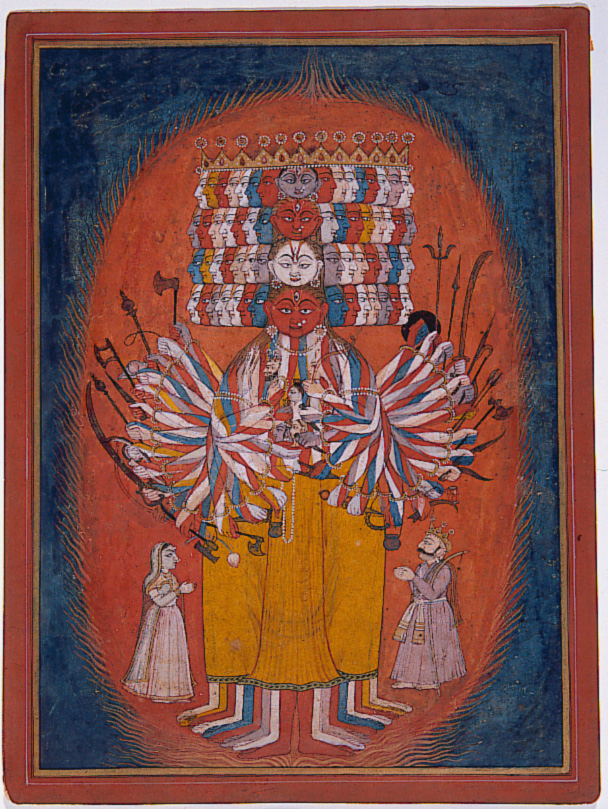
"Now I am become Death, the destroyer of worlds" is, by a wide margin, the single most famous line from the Bhagavad Gita outside India, largely because J. Robert Oppenheimer recalled it decades later while describing what went through his mind watching the first successful test of a nuclear weapon. Most people who know the quote have no idea what chapter it comes from, what Krishna is actually describing when he says it, or why Arjuna — the person the line was originally spoken to — reacts to hearing it with outright terror rather than awe. The full scene, in chapter 11, is stranger and more specific than the isolated quote suggests.
Why Arjuna Asks to See This in the First Place
Chapter 11 doesn't open with Krishna deciding to reveal himself unprompted — it follows directly from chapter 10, in which Krishna has just spent an extended passage listing his manifestations across the created world, identifying himself with the finest or most essential example within one category after another. Having heard this, Arjuna makes a direct, specific request: having heard Krishna describe his own divine glories in this much detail, Arjuna now wants to actually see the form behind the description, not just hear it catalogued in words.
Krishna's response contains an important detail that's easy to skip past: he tells Arjuna plainly that his ordinary human eyes are not capable of perceiving this form, and grants him a special "divine eye" specifically for the purpose — the vision that follows isn't something anyone standing on that battlefield could have simply looked over and seen with unaided sight. This matters for how the whole scene should be read: it's explicitly framed as an exceptional, granted perception, not an everyday visible fact Krishna had simply been concealing.
What Arjuna Actually Sees
What follows is one of the most sustained, deliberately overwhelming descriptions in the entire text. Arjuna perceives countless mouths, eyes, and arms, a form blazing with a brilliance compared to a thousand suns rising simultaneously, and the entirety of the universe — all gods, all sages, every being that exists — contained simultaneously within this single, boundless body. It's worth being clear that the text doesn't present this as a serene or comforting sight, the way a modern reader might expect a vision of ultimate divine reality to be described. It's consistently rendered as overwhelming, awe-inducing in the older sense of that word — awe as something closer to dread than pleasant wonder.
The specific detail that pushes the vision from merely awesome into genuinely terrifying is Arjuna watching the warriors of both armies — men he knows personally, on both sides of the war he's about to fight — rushing headlong into the countless blazing mouths of this form and being destroyed there, and Krishna offers his own simile for it: like moths rushing with full speed into a blazing fire. Arjuna is watching, in real time, everyone present at Kurukshetra being consumed, which is the specific moment the chapter's most famous line arrives in response to his question about what this form actually is.
What "I Am Become Death" Actually Says, and a Real Translation Dispute
Asked directly what this terrifying form represents, Krishna answers with the line usually rendered in English as "I am become Death, the destroyer of worlds" — the specific phrasing Oppenheimer used decades later, drawing on a well-known English translation. It's worth knowing that this rendering, while widely repeated, reflects one interpretive choice among the possible ways to translate the underlying Sanskrit word, kala. Kala more literally and directly means "time" rather than "death" specifically, and a number of scholars and translators argue "I am Time, the great destroyer of worlds" is the more accurate reading — with "death" being an evocative, dramatically compressed English choice rather than the most literal one available. Either translation lands on the same underlying claim: Krishna, in this form, identifies himself with the force that inevitably brings all created things to their end regardless of any individual's action or intention, and adds that the warriors Arjuna is watching be destroyed are, in a real sense, already slated for that end by this same cosmic force, with or without Arjuna's own participation in the battle.
Why the Vision Ends With Krishna Returning to a Gentler Form
Arjuna's reaction to all of this is not devotion or comfort but visible distress — the text describes him trembling, his hair standing on end, and he explicitly asks Krishna to stop, addressing him with something close to an apology for having previously treated him only as a friend and companion without recognizing this cosmic dimension of who he actually was. Krishna's response is to withdraw the terrifying universal form and return first to a gentler four-armed divine form, and finally back to the familiar human shape Arjuna has known throughout the rest of the text, reassuring him directly: do not be afraid, look on this gentle form again, and be at peace.
That specific narrative arc — request, overwhelming and frightening revelation, and a deliberate return to something more bearable — is worth taking as seriously as the vision itself. The chapter isn't arguing that ultimate reality is comforting once properly perceived; if anything, it's fairly direct that a genuinely complete vision of it is close to unbearable for an ordinary embodied person, and that the gentler, personal, relatable form of the divine Krishna has occupied for the rest of the text isn't a lesser or incomplete version of the truth being politely offered to someone not ready for the real thing — it's presented as a genuine mercy, deliberately chosen and returned to, that makes an otherwise overwhelming reality something a person can actually stand in relationship with. That's a real, and rarely noticed, argument in favor of bhakti, the devotional path already covered in this series — not merely an easier alternative to direct metaphysical realization, but arguably the only form in which ultimate reality can be approached at all without the kind of terror chapter 11 describes in vivid, specific detail.

Written by Ravindra Valand
Founder and researcher at AnuSutra. Tracing ancient Sanskrit scriptures (Vedas, Upanishads, Bhagavad Gita) directly from canonical Sanskrit manuscripts, exploring the nexus between contemplative spiritual practices and modern cognitive science.