
The Mundaka Upanishad: Satyameva Jayate and the Parable of the Two Birds
India's national motto comes from a three-part Upanishad attached to the Atharvaveda — and the line right before it, about two birds on the same branch, is arguably the more important teaching.
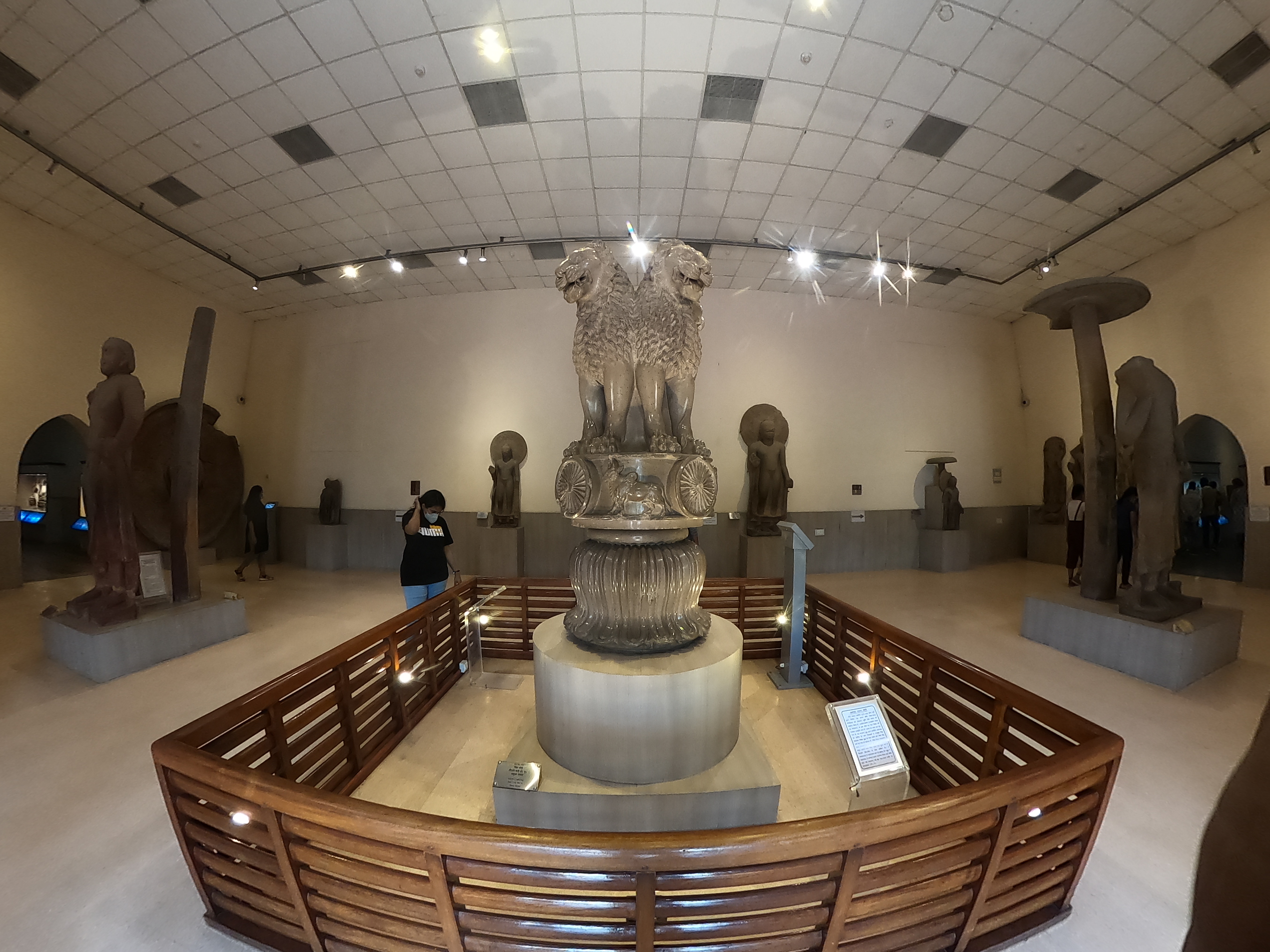
[!CANONICAL SOURCE & NATIONAL MOTTO REFERENCE]
- National Motto: Satyameva Jayate (सत्यमेव जयते — "Truth Alone Triumphs")
- Exact Scriptural Source: Mundaka Upanishad, Chapter 3, Section 1, Mantra 6 (Mundaka 3.1.6)
- Veda Affiliation: Associated with the Atharvaveda (Shaunaka Shakha)
- Full Mantra: सत्यमेव जयते नानृतं सत्येन पन्था विततो देवयानः ("Truth alone triumphs, not untruth; by truth is paved the divine path...")
- National Adoption: Inscribed at the base of the Lion Capital of Ashoka on 26 January 1950.
Most people who can recite India's national motto have never read the line that comes right before it. "Satyameva Jayate" — truth alone triumphs — sits at Mundaka Upanishad 3.1.6, inscribed below the four lions of the national emblem since the motto was formally adopted in 1950. What almost never makes it into the civics-textbook version is verse 3.1.1, five lines earlier in the same chapter: two birds, inseparable companions, perched on the same tree. One eats the tree's fruit. The other watches, eating nothing at all.
The Mundaka Upanishad puts these two images within a few verses of each other on purpose. One is about what happens when a person finally reaches the truth. The other is about the entire structure of a mind that hasn't yet gotten there — which, on this text's own accounting, is most minds most of the time.
A Text Attached to the Atharvaveda
The Mundaka Upanishad belongs to the Atharvaveda, one of the four Vedas, and is organized into three "Mundakas" — the word literally means something like a shorn or shaved section, plausibly evoking the image of shaving away ignorance to expose what's underneath — each split into two shorter khandas. It's a Mukhya Upanishad, meaning it belongs to the dozen or so oldest and most authoritative texts in the genre, the ones every later Vedantic commentator felt obliged to write a formal commentary on.
Its opening move is one of the more useful pieces of intellectual housekeeping in the entire Upanishadic corpus: a hard line drawn between two kinds of knowledge. Verses 1.1.4 and 1.1.5 name them apara vidya, the lower knowledge, and para vidya, the higher. Apara vidya covers the four Vedas themselves along with the auxiliary sciences that support ritual practice — phonetics, grammar, etymology, meter, astronomy, and the rules of sacrifice. Para vidya is described as the knowledge "by which the Imperishable is apprehended." The Mundaka doesn't dismiss the lower knowledge as worthless — elsewhere the Vedas are treated with real reverence — but it does something bolder than most sacred texts attempt about their own tradition: it explicitly ranks a form of knowledge above scriptural study and ritual correctness, and then spends the rest of its length explaining what the higher one actually is.
"By Knowing Which, Everything Else Becomes Known"
Verse 1.1.3 poses the question that sets up the whole text, and it's worth sitting with because of how unusual the framing is. A student named Shaunaka approaches the sage Angiras and asks: what is that, knowing which, everything else becomes known? Not "what is the highest truth" in the abstract, but a much stranger and more specific claim — that there exists some single thing whose knowledge makes every other piece of knowledge fall into place, the way learning one fact about clay lets you understand every object made of clay without inspecting each one individually. (The Chandogya Upanishad makes essentially the same argument with the same clay analogy, in its own separate teaching on Brahman.) The rest of the Mundaka is Angiras's answer to that one question, and the answer, unsurprisingly for an Upanishad, is Brahman — the single reality underlying and unifying everything that exists, known and knowable.
Truth Alone Triumphs
The verse that actually contains "Satyameva Jayate" appears at the close of the third Mundaka's first section, and it says considerably more than the three-word slogan suggests in isolation. The fuller sense of 3.1.6 is that truth, not falsehood, is what wins out — and that through truth a path unfolds, one that sages whose desires have been fully satisfied follow to reach the "supreme treasure" the verse describes as truth's own resting place. It's less a promise about worldly justice (truth winning arguments, truth winning trials) than a claim about spiritual attainment specifically: the path to liberation runs through truthfulness, and those who've stopped wanting anything else are the ones capable of walking it all the way.
India's Constituent Assembly adopted the phrase as the national motto in 1950, choosing a line from a 2,000-plus-year-old philosophical text over anything more recent or more explicitly political — a decision that says something about how central this particular strand of Upanishadic thought remained to 20th-century Indian self-understanding, independent of any specific religious observance.
The Parable Right Before It
But it's verses 3.1.1 through 3.1.3 — the passage immediately preceding the "Satyameva Jayate" verse in the same chapter — that carries the Mundaka's more demanding philosophical content. Two birds, described as sayuja, inseparable friends, cling to the same tree. One of them eats the tree's sweet fruit. The other looks on without eating anything at all.
The traditional reading, laid out across centuries of commentary starting with Shankara's, takes the two birds as two ways of describing the same location — the individual self and the supreme self, both present in one body, the way two birds can share one branch without being the same bird. The eating bird is the jiva, the individual self entangled in experience, consuming the fruits of its own actions, tasting pleasure and pain, sweetness and bitterness, because it's convinced that's what it is and that's what it's for. The bird that merely watches, untouched by any of it, is the paramatman — the same self, seen without the entanglement, present at every moment as a kind of silent witness that was never actually eating anything to begin with.
The point of the parable isn't that there are two selves. It's that there's one self capable of misidentifying itself as the eating bird — mistaking the entangled, tasting, suffering participant for the whole of what it is — and that the entire crisis the Upanishad exists to resolve is exactly this case of mistaken identity. Verse 3.1.2 makes the resolution explicit: when the eating bird finally looks over and sees the other bird — sees its own true nature as the untouched witness rather than the consumer of fruit — its grief ends. Not because circumstances changed. Because it stopped believing it was the bird that was suffering.
This same image, essentially unchanged, also appears in the Svetasvatara Upanishad at 4.6–4.7, and in an even older form all the way back in the Rigveda at 1.164.20 — one of the clearest examples in the entire Vedic corpus of a single striking image surviving, largely intact, across what's probably close to a thousand years of textual transmission, carried from the oldest layer of Vedic poetry through to its fullest philosophical treatment in the Upanishads.
The Bow, the Arrow, and the Target
The Mundaka doesn't stop at description; it also offers what amounts to a practice instruction, using a second extended image in its second chapter. Verse 2.2.4 tells the student to take up the bow of Upanishadic knowledge, place upon it an arrow sharpened by meditation, draw it back with a mind absorbed in Brahman's nature, and strike the target — the Imperishable itself. Om, the syllable, is named as the bow; the individual self is the arrow; Brahman is what's to be struck. It's an unusually kinetic, almost martial metaphor for a text otherwise concerned with stillness and witnessing, and later commentators have taken it as evidence that the Mundaka's idea of "knowledge" was never meant as passive intellectual assent — it's something closer to disciplined, effortful aim.
What Two Very Different Verses Are Actually Doing Together
Read side by side, "Satyameva Jayate" and the two-birds parable turn out to be making a coordinated argument rather than sitting in the same chapter by coincidence. The motto states the destination: a path exists, truth is what it's paved with, and something describable as a "supreme treasure" waits at the far end of it for those who've stopped wanting anything else badly enough to be pulled off course. The parable diagnoses the starting condition that makes the path necessary at all: a self so thoroughly convinced it's the bird eating the fruit — tasting, grasping, grieving over what it's lost or hasn't yet gotten — that it's failed to notice the other bird sitting one branch away the entire time, untouched, unmoved, and, on the Mundaka's own account, actually what it already is.
Discover Your Dominant Guna Constitution
Evaluate your balance of Sattva, Rajas, and Tamas according to Chapter 14 of the Bhagavad Gita with our self-inquiry quiz.

Written by Ravindra Valand
Founder and researcher at AnuSutra. Tracing ancient Sanskrit scriptures (Vedas, Upanishads, Bhagavad Gita) directly from canonical Sanskrit manuscripts, exploring the nexus between contemplative spiritual practices and modern cognitive science.
Related Sacred Studies
The Four Mahavakyas: The Upanishads' Great Sayings, Explained Together
Four short sentences, one drawn from each of the four Vedas, are traditionally treated as the compressed summary of everything the Upanishads are trying to say. Read separately they sound like four different claims. Read together, they're one.
The Isha Upanishad: Renunciation and Enjoyment in a Few Verses
One of the shortest Upanishads ever written spends barely twenty verses solving a problem most traditions never fully resolve: whether the spiritual life requires giving up the world, or engaging fully with it.
The Katha Upanishad: Nachiketa's Dialogue with Death
A boy sent to the house of Death by his own father refuses every bribe Death offers him — kingdoms, long life, every pleasure the senses can hold — until Death finally answers the one question that matters. That refusal is the entire Katha Upanishad.